
Where Manufacturing Companies Are Quietly Losing Money
Labor and materials are major costs. They are not always the biggest cost drivers. Operational friction is a larger problem. This friction builds up over years. It becomes a standard part of your workday. You might not notice it anymore.
1. Siloed and Disconnected Systems
Many factories use different systems for different tasks. Sales uses one platform. Operations uses a different one. Accounting uses a third system. These systems do not talk to each other. Your employees must move data manually. They copy information from one screen to another. They re-enter the same numbers multiple times.
This creates several problems for your shop floor:
- Administrative overhead increases.
- Data becomes inconsistent across departments.
- Projects experience delays during hand-offs.
You can fix this by integrating your systems. Integration removes the need for manual data transfer. It saves hours of work every day.
2. Repetitive Manual Tasks That Add Little Value
Your team performs many manual workflows. These tasks are necessary for the business. They do not add high value to your products.
Common manual tasks include:
- Generating quotes for new orders.
- Processing incoming orders into the system.
- Entering production data into spreadsheets.
- Validating invoices against shipments.
- Sending manual updates to customers.
These tasks take up the time of skilled workers. Digital automation handles these tasks instead. This allows your team to focus on production and quality. You can see how this works on our solutions page.

3. Knowledge That Lives Only in People’s Heads
Tribal knowledge is a risk. It is one of the most overlooked costs in manufacturing. A senior technician knows how to fix a specific machine. A supervisor knows a shortcut to avoid downtime. This information is not written down.
When these people leave or retire, the knowledge is gone. This leads to specific problems:
- Your team makes the same mistakes repeatedly.
- Onboarding new hires takes months instead of weeks.
- Training gaps lead to safety and quality issues.
- Productivity drops when experts are unavailable.
Capturing this knowledge digitally improves your efficiency. It makes your organization less dependent on specific individuals. For more on this, read our guide on reducing training ramp times.
A Small Mistake That Became a Six-Figure Problem
Manual processes lead to human error. I worked with a manufacturer who used manual quoting. They pulled pricing from several different files. They typed these numbers into a document.
One employee entered a wrong digit. It was a simple mistake. The process had no automatic checks. The error was not found before the quote was sent. The company lost over six figures in revenue because of one typo.
This is a common occurrence. Automation prevents these errors. It includes validation checks. It ensures your data is accurate before it reaches the customer.
Digital Tools That Deliver the Biggest ROI
Not every technology is a good investment. You must choose tools that provide a clear return. Some tools consistently perform well in manufacturing environments.
AI-Powered Automation
AI handles repetitive tasks. It can process documents and validate data. It can generate quotes and communicate with customers. AI does not replace your workers. It removes the boring parts of their jobs. This speeds up your entire operation.
System Integrations
Integrate your ERP and CRM systems. This allows information to flow automatically. Sales orders go directly to production. Production data goes directly to accounting. You reduce errors. You save time on every order.
Knowledge Capture Systems
Use a system to store operational expertise. This makes training easier. It helps with troubleshooting machines. It ensures that everyone follows the same documentation. This improves your overall knowledge retention.
Data Dashboards
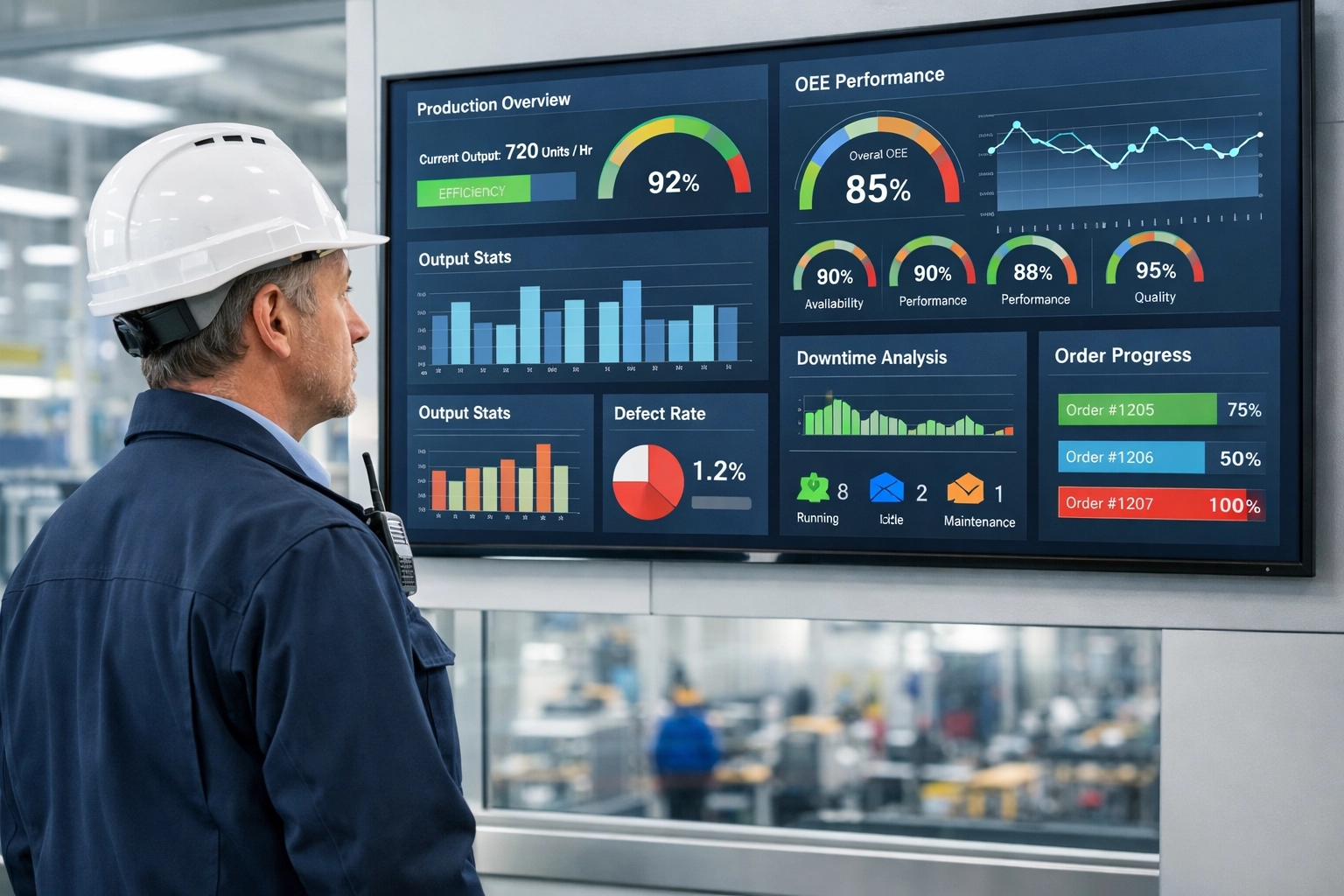
Many leaders lack real-time visibility. Dashboards show you exactly what is happening. You can see bottlenecks in production. You can track performance trends. You can identify cost drivers before they become problems. Visibility leads to better decisions.
Predictive Maintenance and Waste Reduction
Research shows that digital transformation also saves money through maintenance. You can use sensors to monitor your equipment. This is called predictive maintenance.
Follow these steps for predictive maintenance:
- Identify your most critical machines.
- Install IoT sensors to track vibration or temperature.
- Connect the sensors to an analytics platform.
- Monitor for changes that indicate a future failure.
- Schedule repairs before the machine breaks down.
This minimizes downtime. It reduces the cost of emergency repairs. Digital tools also reduce waste. You can use data to optimize resource allocation. In steel manufacturing, models have reduced material costs by up to 5%. They do this by targeting inputs more precisely. Better resource management lowers your scrap rate.
Why Many Manufacturers Delay Digital Transformation
The benefits are clear. Many companies still wait to make changes. The barrier is often cultural. Some employees have worked the same way for years. New technology is intimidating to them.
Workers often have three concerns:
- Will this technology take my job away?
- Am I capable of learning how to use it?
- Will it stop our current production schedule?
You must address these concerns. You must approach transformation carefully. You need a plan that includes your team.

Our Philosophy: Technology Should Empower Workers
Dellini AI does not recommend layoffs. Our goal is to make jobs easier. We eliminate the tasks that people dislike. We remove tedious and manual work. This creates immediate value.
Your employees can then focus on better work. They can solve problems. They can improve your internal processes. They can build better relationships with your customers. Technology should be a tool for your people. It should not be a replacement for them. You can learn more about us here.
Why We Start With ROI : Not Software
Buying software first is a mistake. This is why many implementations fail. The software may be good. It might not fix your specific problems.
Our process is different:
- We perform an operational audit.
- We identify where you lose time.
- We identify where you lose money.
- We recommend improvements based on ROI.
We start with small changes. These early wins build confidence. They prove the value of the technology. You can book an operational audit here.
The Real Cost of Doing Nothing
You might worry about the cost of new tools. You should also consider the cost of staying the same. Manual processes are expensive. Disconnected systems are expensive. Undocumented knowledge is a financial risk.
These issues cost companies hundreds of thousands of dollars each year. Fixing these inefficiencies has a high financial impact. The return on investment is often much higher than the cost of the technology itself.
Final Thoughts
Digital transformation does not require a massive overhaul. You can start with one process. You can identify one inefficiency and fix it.
The benefits will compound over time. Your factory will become faster. Your team will become more efficient. Your business will be better equipped to grow. This is how you deliver real value through technology. If you are ready to begin, visit our contact page.